Bloomberg / Cloud Computing News
Jul 02, 2026
bearish
Meta Building 'Meta Compute' Unit to Sell Surplus AI GPU Capacity to External Customers
Bloomberg reported on July 1 that Meta is developing a cloud business—internally called Meta Compute—to lease excess AI training and inference capacity alongside hosted model access, putting it in direct competition with AWS, Azure, Google Cloud, and neocloud providers such as CoreWeave and Nebius. Meta's 2026 capex is guided at $125–145 billion, and the disclosure that this buildout has produced surplus sellable capacity shattered the market's scarcity premium: CoreWeave fell roughly 14% and Nebius dropped ~17% on the day. No pricing, launch date, or confirmed customers have been announced, but the signal that at least one hyperscaler has moved from net buyer to potential net seller of GPU capacity is a structural shift for the rental market.
Help Net Security / NTT Data
Jul 07, 2026
neutral
Power Shortages Identified as Key Constraint on AI Data Center Expansion
An NTT Data analysis reported by Help Net Security found that AI data center operators are running into binding limits around power access, land, permitting, and equipment lead times—with large power transformers carrying multi-year delivery schedules. The report notes that GPU-dense AI infrastructure requires significantly more electricity and advanced cooling than conventional workloads, and that access to grid capacity is now a deciding factor in where and when new compute supply comes online. The constraint acts as a structural ceiling on how quickly new GPU rental capacity can be brought to market, partially offsetting demand-side pressure on rental prices.
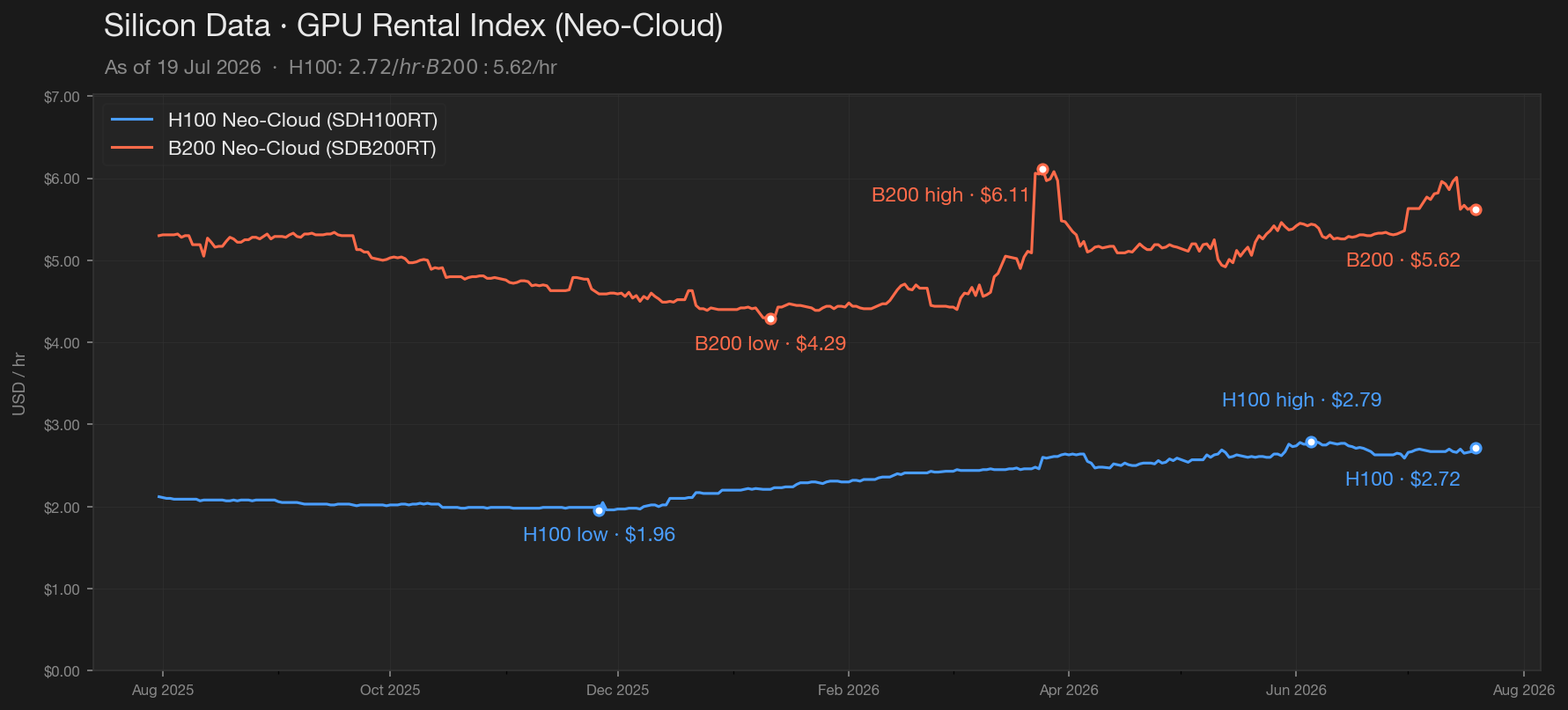
The H100 Neo-Cloud index edged up to $2.72/hr (+1.9% over 10 days, +0.4% over 30 days), consistent with a market that has largely stabilised after the steep declines of 2024-25. Spot pool tightness—with at least one neocloud reporting H100 spot pricing momentarily above on-demand—supports the view that residual demand is absorbing available inventory rather than creating meaningful upward price pressure. The B200 Neo-Cloud index sits at $5.62/hr, down 3.4% over 10 days but still up 5.8% over 30 days, reflecting the volatile price discovery still underway for Blackwell-class capacity where confirmed stock availability remains thin (sub-40% across tracked providers). The dominant macro signal this week is Meta's disclosure that it has built enough surplus GPU capacity to enter the cloud rental market, a development that sent neocloud equities sharply lower and injected meaningful uncertainty into medium-term pricing dynamics. Power and data-center infrastructure constraints remain a structural supply ceiling, partially offsetting any near-term softening from Meta's potential new supply.